
County Pay Decisions
Backed by Real Data.
County Compensation Survey gives HR administrators and county officials the benchmarking data, transparency tools, and expert consulting to make defensible, equitable pay decisions — every quarter.
Why County Comp Survey
Everything Your County Needs.
Nothing You Don't.
Transparent
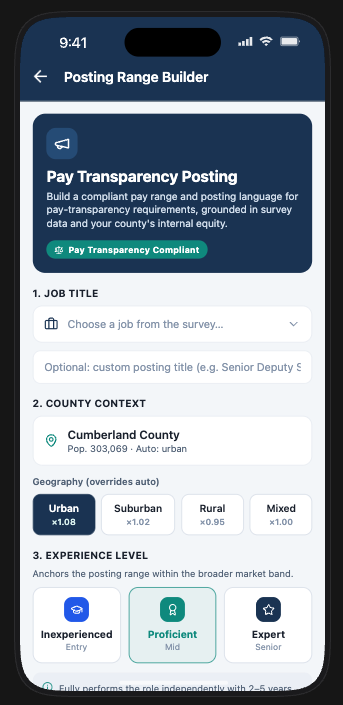
Meet state pay transparency mandates with confidence. Our platform gives you the documentation, methodology, and salary range data to comply with both the spirit and the letter of the law.
Complete
See the full Total Compensation picture — not just base pay. Benefits, allowances, and other pay elements are included so HR administrators can benchmark the entire compensation package.
Cost-Effective
Stop paying for one-off salary reports or hiring outside consultants for every benchmarking question. County Comp Survey gives your team always-current data at a fraction of the cost.
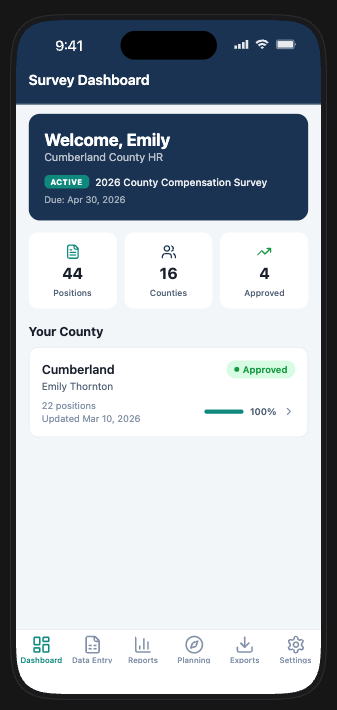
Precision Benchmarking
County-Specific Pay Data
Not Generic Market Surveys.
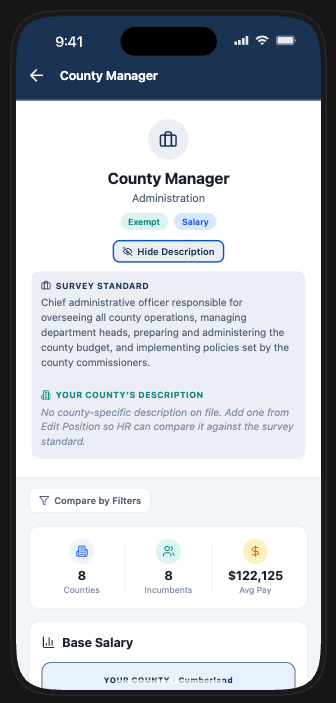
Generic national salary surveys weren't built for county government. Our data is collected directly from county administrations — giving you peer comparisons that actually reflect your competitive landscape.
- Compare pay across roles within your county and neighboring counties
- Filter by population size, region, and job family
- Refresh quarterly so data doesn't go stale mid-fiscal-year
- Drill down to position-level detail, not just broad job families
Compliance Ready
Support State Pay
Transparency Regulations.
Pay transparency laws are reshaping what public sector organizations must disclose. County Comp Survey gives administrators the tools to build defensible salary ranges and communicate pay practices with clarity.
- Pre-built salary range documentation templates
- Compliance tracking against state-specific requirements
- Clear reporting for elected officials, boards, and the public
- Methodology documentation that holds up to public scrutiny
Expert Consulting
Data Is Just the Starting Point.
Our team has spent decades building and running compensation surveys for county and municipal governments. When the data raises questions, we're here to answer them.
Compensation Analysis
We don't just hand you data — our consultants have access to the full county database and additional benchmarking sources to help you build and defend your pay structure.
County Compensation Expertise
We are the team behind the survey. We understand the nuances of public sector pay — union contracts, elected official compensation, classification challenges, and total rewards.
Beyond Total Compensation
Compensation, Benefits, and Workforce Management. Whether you need a full pay structure build or targeted analysis, our team supports you through implementation.
Who the survey is built for
Built for the people who run the county
County pay decisions get made — and questioned — by different people, for different reasons. The survey answers each of them.
You have to defend the number
To commissioners, to taxpayers, to the union across the table.
- Bargaining. Independent, third-party comparables — so you're not negotiating against the union's numbers with none of your own.
- Budget cover. Turn a subjective ask into a benchmarked decision you can stand behind in an open meeting.
- Compliance. Post defensible salary ranges as state pay-transparency laws take effect.
You have to fill the seat
And keep the people you already trained from leaving.
- Recruit & retain. Current market rates so your offers and retention raises hold up.
- Real competitors. Rates from the specific counties in your state you actually lose candidates to.
- Matching done for you. We normalize the job titles — no comp analyst on staff required.
Forecast with confidence
Forecast personnel costs using current, county-specific compensation data.
Show accountability
Support public accountability with clear, documented pay practices that hold up to scrutiny.
Partners Include
Ready to Get Started?
Better Compensation Data for Your County.
Request a demo and see how County Compensation Survey can improve your pay decisions, transparency practices, and administrative efficiency.